
The US trade war has prompted India to rethink China. While relations might be short of a breakthrough, deeper engagement is here to stay
Published: 4:30pm, 22 May 2026
Perhaps the most fascinating and important aspects of US President Donald Trump’s jolt to the global economy have been its unintended consequences, especially the impact on relations between China and India.
Two consistent aspects of Trump’s meandering narrative are to “make America great again” by bringing manufacturing jobs back to the US, and to hobble China as an economic and strategic threat.
A decade later, there has been negligible progress on either objective. Instead, the unintended consequences have been colossal, and comprehensively harmful to US interests. The impact on Washington’s reputation as an anchor for global economic stability has been nothing short of catastrophic. The reshoring of manufacturing – and evidence of any resultant economic stimulus or job creation – remains negligible, if not invisible.
China’s rise is also unimpaired, not least due to its strategic consistency, unwavering advocacy and preference for multilateral problem-solving, and its role in enabling the parallel rise of the Global South, which brings us to its relations with India.
One consistent conundrum of the past eight decades has been the suspicion and rivalry between New Delhi and Beijing. Rivalry has some rational foundations: both countries have colossal populations, civilisations that go back thousands of years and strong rival claims to stand as champions of the developing world.
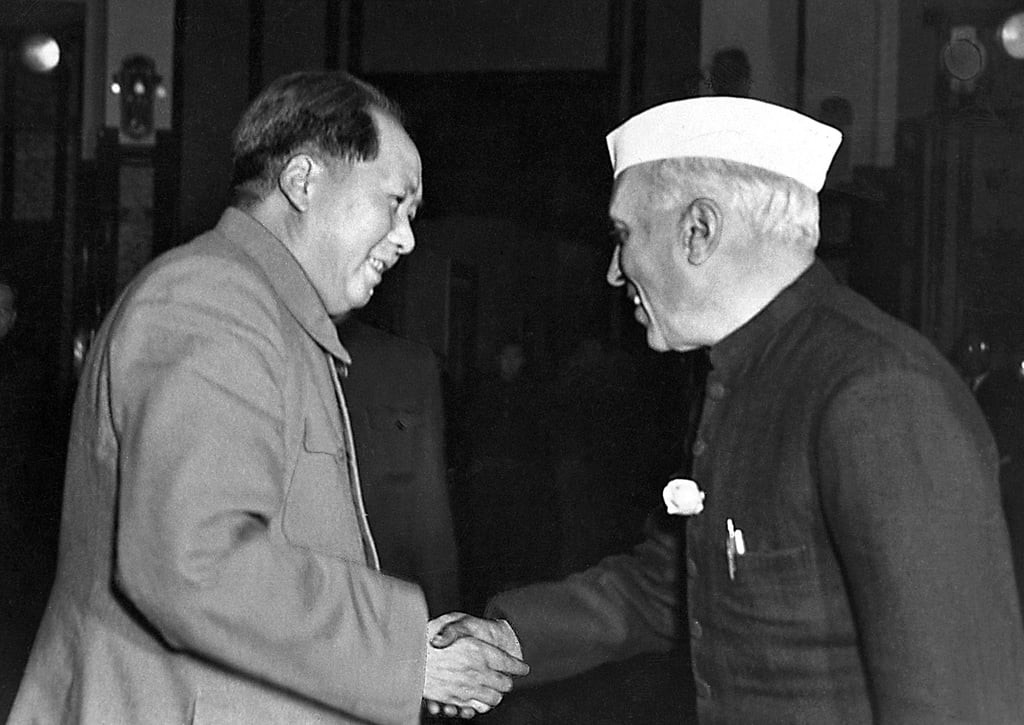
Indian Prime Minister Jawaharlal Nehru shakes hand with Chinese leader Mao Zedong in 1954 in Beijing. Photo: AFP
By 1950, shortly after India broke free from British colonialism and China’s Communists pushed the US-backed Kuomintang government into exile on the island of Taiwan, both countries had espoused highly contrasted models of socialism. As China under Mao Zedong focused on tackling the deep internal wounds of a decades-long civil war, India rose as a leader of the Non-Aligned Movement.
In the 1970s, especially amid striking progress orchestrated by Deng Xiaoping, China emerged to contest India’s role and encroach on the latter’s interests in Asia. China’s rise was an economic challenge and slap in the face for India’s stumbling growth model.
Instead of building strong links as neighbours and the world’s most populous economies, India and China have looked away from, rather than towards, each other, arguably to the benefit of neither. A military skirmish in Galwan Valley in 2020 cauterised relations. While the two sides eventually agreed to disengage troops from the disputed border region in 2024, trade and investment came to a grinding halt. Direct flights between the two countries were cut amid the Covid-19 pandemic.
In spite of logic suggesting that the two countries have strong interests and challenges in common, they have bristled since. In the quest for strategic autonomy, India has sought trade and diplomatic linkages almost anywhere but China.
Despite its interests tied to the developing world, India joined the Quadrilateral Security Dialogue defence grouping with the United States, Japan and Australia. It has rejected membership of the Southeast Asia-facing Regional Comprehensive Economic Partnership, alongside China, for fear of enabling Chinese companies to break into the Indian market. It has similarly refused to join the Belt and Road Initiative.
It has built close links with Israel at the risk of jeopardising relations with its Muslim-majority neighbours. And its biggest trade deal to date was signed with Europe.
But a key unintended consequence of Trump’s trade-related policies has been to call into question the entire logic of India’s security strategy. As Trump has taken a unilateral wrecking ball to the architecture of multilateral trade, China has seemingly emerged as a much more trustworthy partner in trade and multilateral stability.
The Covid-19 pandemic, Trump’s chaotic trade policies and disrupted shipping through the Strait of Hormuz following the US war on Iran have forced numerous governments to rethink “de-risking”. India likewise is rethinking its implicit “anywhere but China” approach, albeit strategically.
The “China plus one” strategy, adopted by many companies to avoid fallout from Trump’s tariff wars, brought investment into India. Apple’s shift of iPhone production to India is a case in point. This dynamic has guided a “cautious re-engagement” with China. As the London-based Atlas Institute for International Affairs noted in December, we are seeing evidence of normalisation and coexistence rather than friendship, and “breathing room rather than breakthrough.”
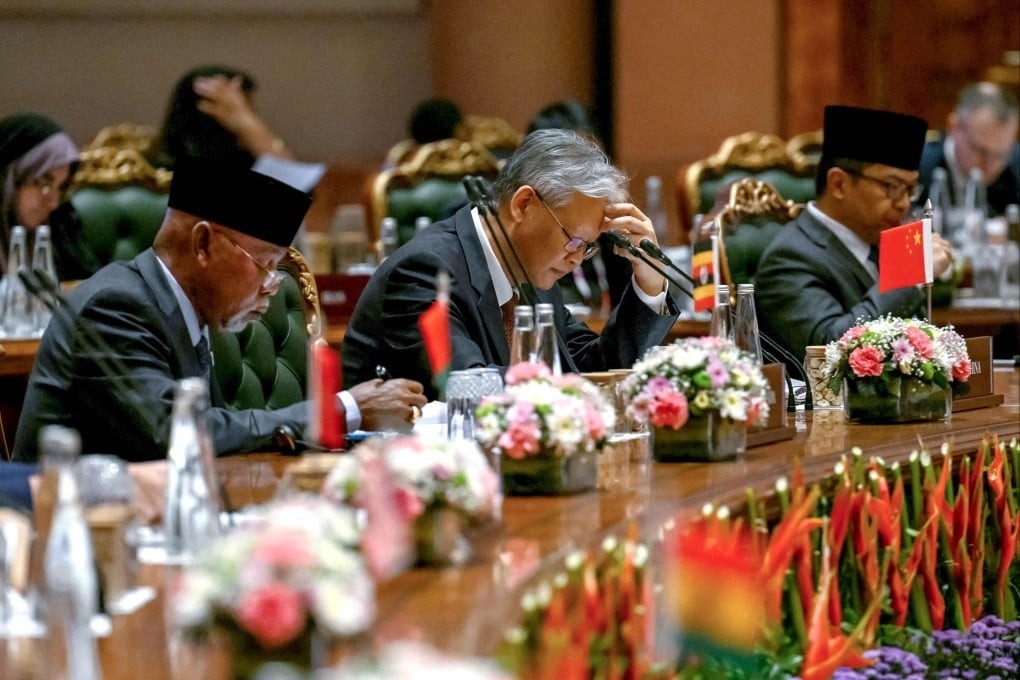
Xi Jinping and Narendra Modi hold first formal talk since deadly border clash, some trust is being built via Brics. Moreover, the Shanghai Cooperation Organisation offers a platform where the two can meet (along with Pakistan and Iran) to discuss Central Asian challenges.
As Chinese Ambassador to India Xu Feihong said during his Chinese New Year speech in New Delhi, “China stands ready to strengthen strategic alignment with India, deepen practical cooperation, enhance people-to-people exchanges and strengthen multilateral coordination.” Meanwhile, India China Trade Centre executive vice-chairman Vijay Mishra acknowledged “the vast untapped potential for deeper economic engagement, industrial collaboration and value-chain integration”.
The data could hardly shout louder. The two countries account for around 35 per cent of the world’s population over 40 per cent of the world’s gross domestic product growth. In 2025, China added US$1.2 trillion to the world economy, and India US$237 billion. That is just under the US$1.6 trillion added by the US. As each country’s wealth rises, their consumer markets are now among the largest in the world.
Years of mutual suspicion will not disappear overnight, but the cautious rebuilding of business links between India and China seems unlikely to reverse. Most importantly, this might never have happened if Trump had not so incautiously waged war on the multilateral trading system. It is an unintended consequence for which Trump may pay a high price.
Source: Source: https://www.scmp.com